
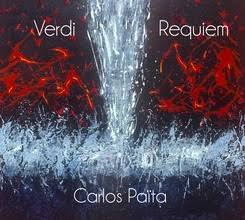
Cette version, une fois de plus extraordinaire, du Requiem de Verdi, par Carlos Païta, remastérisée dans un son de grande qualité (et tenant sur un seul CD!). Livret par André Hirt.
Ici la recension dans Pizzicatto par Remy Franck (que je remercie).
(For English, please scroll down)

Für seine Einspielung des Verdi-Requiems hatte Carlos Païta 1975 ein erstrangiges Ensemble zusammengestellt, exzellente Solisten, ein gutes Orchester und vor allem den von John Alldis in gewohnter Qualität vorbereiteten London Philharmonic Choir.
Dessen Klang formt Païta mit teils zarten, weichen, teils mit stählernen Händen. Der Introitus beginnt magisch und entwickelt schönste lyrischen Qualitäten, wenn die Solisten einsetzen.
Im Dies Irae und im Tuba Mirum leuchtet Païta die Partitur bis in die feinsten Details aus, bringt ihre polyphone Struktur, die sublime Verflechtung des großen Orchesters, der Chore und der Solostimmen mit größtem Reichtum zu Gehör.
Sopranistin Heather Harper überzeugt mit einer einzigartigen Mischung aus stimmlicher Wärme und emotionaler Tiefe. Karajans Fricka im Ring, Josephine Veasey, brilliert mit wunderbaren Vokalfarben. Carlo Bini, der nicht als besonders feiner und stimmschöner Tenor in Erinnerung ist, wird von Carlos Païta zu durchaus gutem Singen gebracht, lyrisch mit mediterranen Klang und ohne jenes übertriebene Vibrato, das man schon von ihm gehört hat. Der sonore, kultiviert-weiche Bass von Hans Sotin vervollständigt als typischer Basso Cantante das Quartett.
Die Kompromisslosigkeit im Zugriff auf Verdis Notentext, die detailreich herausgearbeitete Rhetorik der Phrasen, die hochdramatische Intensität im musikalischen Ausdruck und nicht zuletzt die phänomenale Konzentration und Disziplin, die Païta seinen Musikern abverlangt, machen diese Aufnahme zu einem herausragenden Tondokument, mittig zwischen der tief religiösen Interpretation eines Karajan oder eines Abbado und der theatralischen, opernhaften Annäherung Bernsteins und Mehtas.
Die für Decca im Vierkanal-Verfahren gemachte und von Alain Gandolfi sehr gut restaurierte Aufnahme spielt angenehm mit der Akustik und fördert die Ausdruckskraft Païtas.
For his 1975 recording of Verdi’s Requiem, Carlos Païta assembled a first-rate ensemble: excellent soloists, a fine orchestra, and, above all, the London Philharmonic Choir, prepared by John Alldis to his usual high standard.
Païta shapes the choir’s sound with a touch that is at times delicate and soft, at other times steely. The Introitus begins magically and develops the most beautiful lyrical qualities when the soloists enter.
In the Dies Irae and the Tuba Mirum, Païta illuminates the score down to the finest details, bringing its polyphonic structure—the sublime interweaving of the large orchestra, the choir, and the solo voices—to life with the greatest richness.
Soprano Heather Harper captivates with a unique blend of vocal warmth and emotional depth. Karajan’s Fricka in Wagner’s Ring, Josephine Veasey, shines with wonderful vocal colors. Carlo Bini, who is not remembered as a particularly refined or melodious tenor, is guided by Carlos Païta to sing quite well—lyrically, with a Mediterranean timbre, and without the exaggerated vibrato one has heard from him in the past. Hans Sotin’s sonorous, cultured, and mellow bass, typical of a basso cantante, completes the quartet.
The uncompromising approach to Verdi’s score, the meticulously crafted rhetoric of the phrases, the highly dramatic intensity of the musical expression, and, not least, the phenomenal concentration and discipline that Païta demands of his musicians make this recording an outstanding audio document, well situated between the deeply religious interpretations of Karajan or Abbado and the theatrical, operatic approaches of Bernstein and Mehta.
Recorded for Decca using a four-channel system and superbly restored by Alain Gandolfi, this recording plays pleasantly with the acoustics and enhances Païta’s expressiveness.

0 commentaires